Sharp GP2Y0D80Z0F Infrared Distance Sensor Module
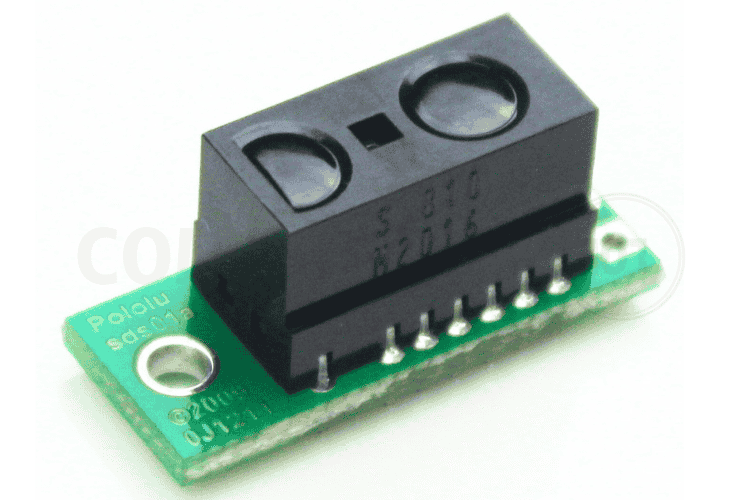
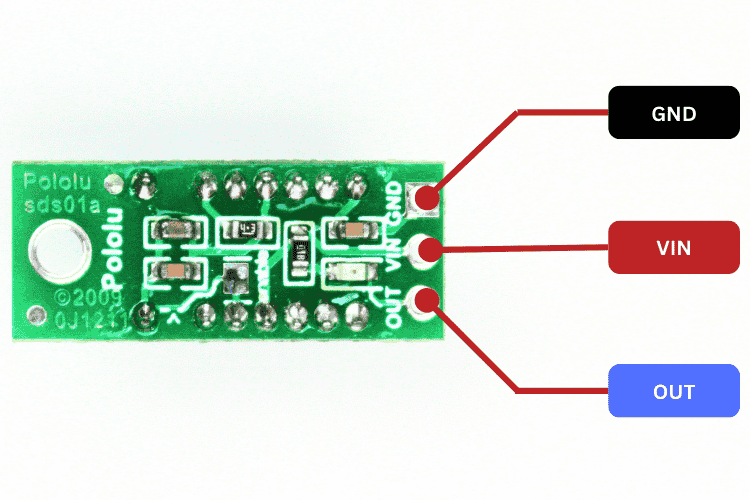
The GP2Y0D810Z0F digital distance sensor is a short-range, non-contact device used for quickly detecting if an object is nearby. It does not measure the distance of an object, but instead it gives a simple on/off signal showing whether something is within a specific range of 2 to 10 centimeters. The sensor comes on a small circuit board with all the necessary parts already included, making it easy to use in electronic projects without any extra processing. This type of sensor is often used when quick response, ease of use, and low power use are more important than precise distance measurements.
Complete Technical Specification of GP2Y0D80Z0F Distance Sensor
According to the official GP2Y0D80Z0F sensor module datasheet, this proximity sensor utilizes infrared triangulation technology to detect objects with high reliability.
|
Parameter |
Value |
|
Sensor Model |
Sharp GP2Y0D810Z0F |
|
Detection Range |
2 cm – 10 cm |
|
Output Type |
Digital (Active LOW) |
|
Operating Voltage |
2.7 V – 6.2 V |
|
Average Current Consumption |
~5 mA |
|
Response / Update Period |
2.56 ms typical (~390 Hz) |
|
Output Logic Level |
LOW ~ 1 V (with onboard LED) |
|
Interface |
Single digital output |
|
Sensing Method |
Infrared triangulation |
|
Mounting |
Carrier PCB with mounting hole |
GP2Y0D80Z0F Sensor Module Pinout Diagram
The image below shows the pinout of the GP2Y0D810Z0F Distance Sensor module. Understanding the GP2Y0D80Z0F sensor module pinout and Arduino connections is essential for proper implementation.
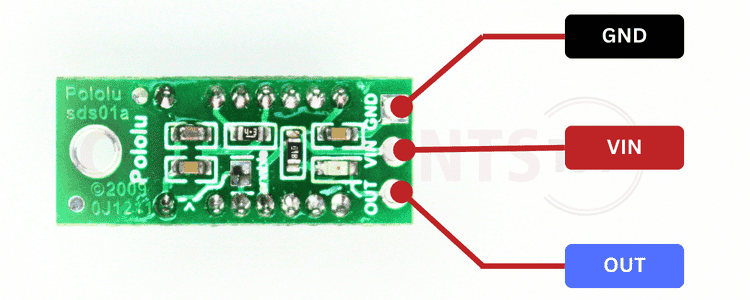
The carrier board exposes a 3-pin header interface; the pinout is explained in the table below. GP2Y0D80Z0F pinout configuration for Arduino and microcontroller connections.
|
Pin |
Name |
Description |
|
1 |
GND |
Ground reference |
|
2 |
VIN |
Power input (2.7 V – 6.2 V) |
|
3 |
OUT |
Digital output (LOW = object detected) |
When interfacing the GP2Y0D80Z0F sensor module with Arduino, connect VIN to the 5V pin for optimal performance, GND to any ground pin, and OUT to a digital input pin (commonly D2 or D3 for interrupt-capable pins).
Key Features and Advantages
The GP2Y0D80Z0F sensor module offers several compelling features that make it a preferred choice for proximity detection applications
-
GP2Y0D80Z0F Sensor Module
-
Object detection using a fixed detection distance
-
No calibration is needed
-
High update rate
-
Low power usage
-
Narrow detection beam
-
Works with both 3.3 V and 5 V microcontrollers
Using the GP2Y0D80Z0F Sensor Module with Arduino
The GP2Y0D80Z0F sensor module Arduino integration is straightforward due to its digital output interface. This module has a simple HIGH/LOW digital signal output that does not require an ADC conversion, so the Arduino digitalRead() function can read it directly.
Basic Arduino connections are as follows:
1. Connect the sensor VIN to your Arduino 5v (or 3.3v if you are using a 3.3v board).
2. Connect sensor GND to Arduino GND.
3. Connect sensor OUT to an Arduino digital pin (e.g., D2).
4. Upload your code and check the serial output to see the status of detection.
Alternatives to the GP2Y0D80Z0F Sensor and Comparison
There are some variants from the same sensor family with different distance ranges. These are some of the GP2Y0D80Z0F sensor module alternatives, which are listed below. When selecting proximity sensors, understanding available GP2Y0D80Z0F sensor module alternatives helps match sensor capabilities to project requirements.
|
Sensor |
Range |
Use Case |
|
GP2Y0D805Z0F |
0.5 – 5 cm |
Ultra-short proximity |
|
GP2Y0D810Z0F |
2 – 10 cm |
General proximity |
|
GP2Y0D815Z0F |
0.5 – 15 cm |
Wider detection |
Modern Alternatives and Comparison
Some newer distance sensors are available as replacements for the GP2Y0D810Z0F. Instead of providing a fixed digital output like the original module, many modern alternatives are designed with analog or pulse-based distance outputs. Improved performance characteristics and wider sensing ranges are typically offered by these newer devices. The following is a list of commonly used analog distance sensors.
|
Sensor |
Range |
Output |
|
GP2Y0A41SK0F |
4 – 30 cm |
Analog voltage |
|
GP2Y0A21YK0F |
10 – 80 cm |
Analog voltage |
Analog sensors sacrifice response speed and simplicity in exchange for continuous distance measurement, making them suitable where distance resolution is required rather than simple presence detection.
Alternative Sensing Methods for Distance Detection
Modern alternatives such as the FlightSense Multi-Zone Distance Sensor, HC-SR04 Ultrasonic Sensor, RCWL0516 Microwave Distance Sensor Module, and VL53L0X - LIDAR Distance Sensor extend capability beyond fixed digital proximity sensing by offering multi-zone time-of-flight mapping, long-range ultrasonic measurement, motion-based microwave detection, and precise laser-based ranging, respectively. Broader coverage, improved accuracy, and flexible analogue or digital outputs are provided, making these devices better suited for robotics, automation, smart occupancy detection, and obstacle-avoidance applications that require richer distance intelligence rather than simple presence triggers.
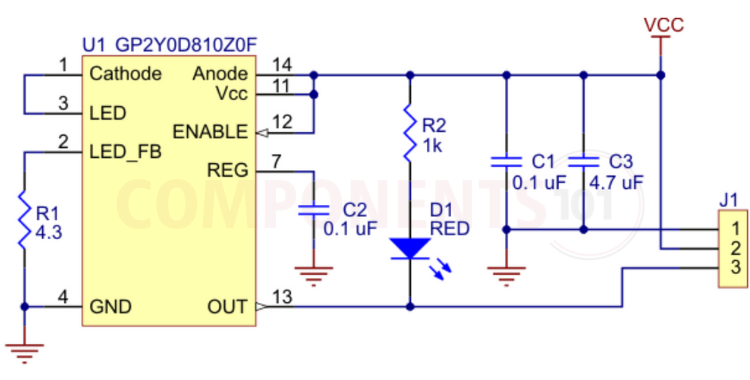
GP2Y0D80Z0F Sensor Module Schematic
The image shows the schematic diagram of the GP2Y0D810Z0F Distance sensor module. The GP2Y0D80Z0F sensor module schematic reveals the internal circuit design, including the Sharp sensor IC, LED driver circuitry, and the 3-pin output interface
Real-World Application Uses
With its ability to provide dependable detection of nearby objects, the GP2Y020D80F can be integrated into products in several industries that need to detect nearby objects for many purposes.
- Robotics: robotic collision avoidance and edge detection, and robotic arms' proximity sensing
- Industrial Automation: verification of presence on parts, detection of objects on conveyor belts and monitoring assembly lines
- Consumer Electronics: touch-free switch, touchless automatic dispensers, and touchless smart trash cans
- 3D Printing: filament presence monitoring, assisting with bed levelling, and sensing open/closed doors
- Arduino: used primarily in educational projects or simply for DIY automated products with basic proximity detection requirements
- Security: detecting entry and exit from an area, alerting when someone opens a drawer and detecting when an object has been tampered with.
Dimensions of the Sensor Module
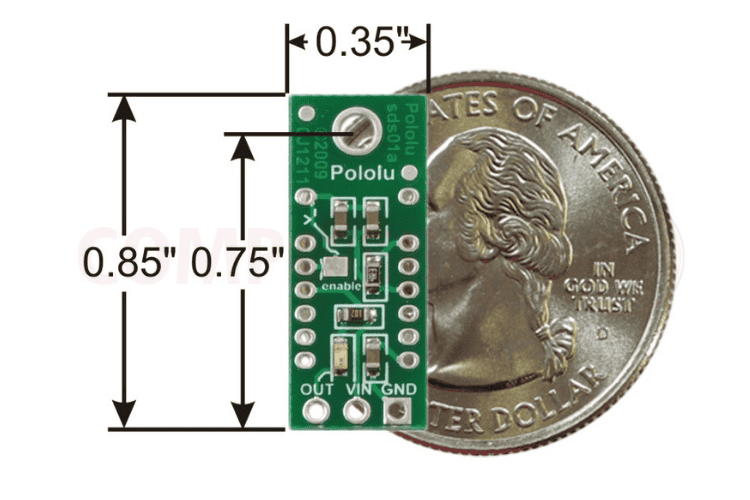
The physical dimensions of the GP2Y0D810Z0F distance sensor module are illustrated below, with a quarter-dollar coin included for size reference. The compact form factor of the GP2Y0D80Z0F sensor module makes it suitable for space-constrained applications.
The official GP2Y0D80Z0F sensor module datasheet provides comprehensive technical information, including electrical characteristics, optical specifications, timing diagrams, and recommended operating conditions.
Some of the important items on a key datasheet are:
- Absolute Maximum Ratings and Detailed Electrical Specifications
- Output Timing Characteristics and Responses
- Distance vs. Reflectivity Charts
- Optical Beam Angle and Detection Zone Geometry
- Operating Conditions (on Environmental basis) and Storage Requirements
- Mechanical Drawings for PC Board Layouts
- Examples of Application Circuits and Design Considerations
The GP2Y0D80Z0F sensor module allows for fast and reliable proximity sensing at short distances. The infrared triangulation technology used in this sensor guarantees consistent detection of objects, whether they are different colours or materials. Included with the GP2Y0D80Z0F sensor module is a complete pinout, schematic, and a variety of alternatives available to help engineers and hobbyists with their short-distance object detection needs.