TDK Introduces New High-Performance Hall-Based Current Sensor IC
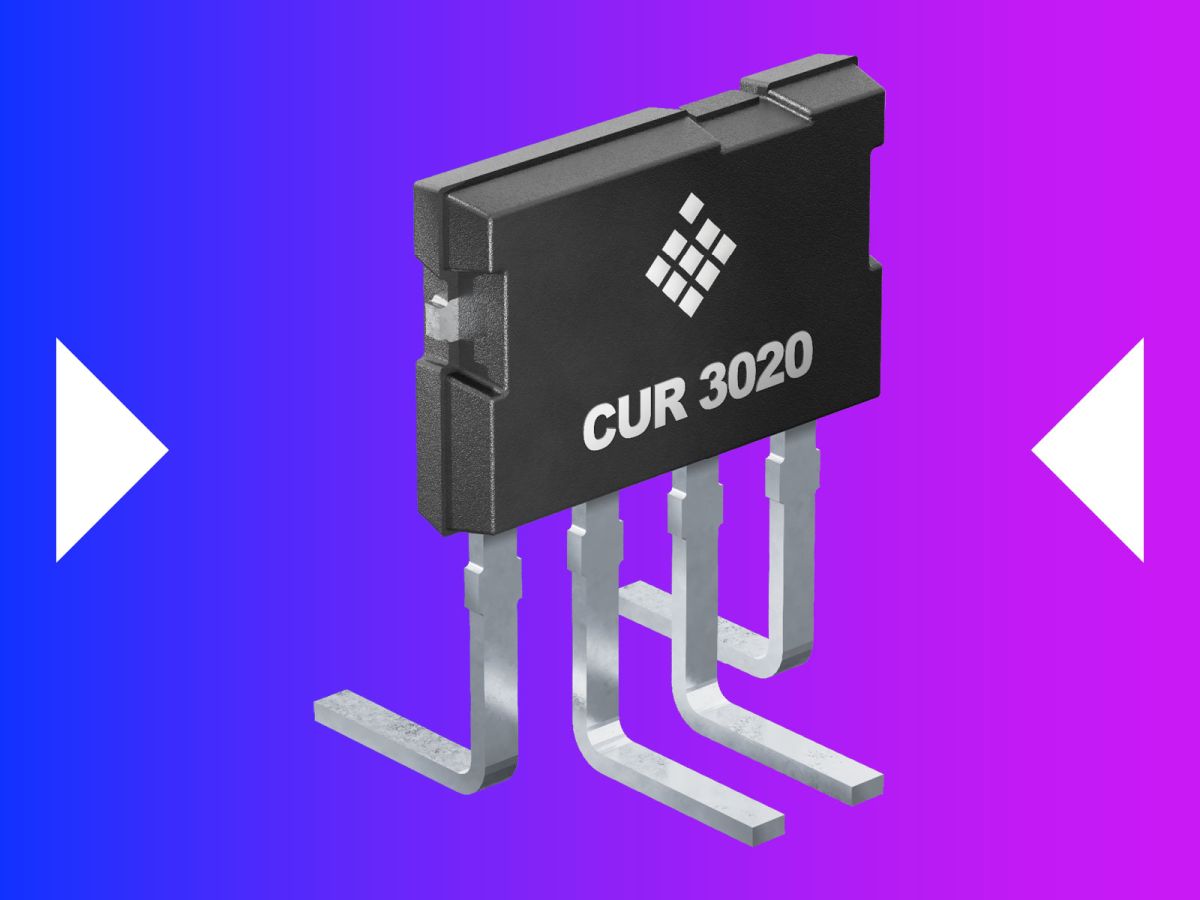
TDK Corporation has introduced the Micronas CUR 3020, a customer-programmable, low-noise, high-accuracy linear Hall-effect current sensor IC. Optimized for use with a C-core concentrator, this device is designed for precise current measurement in high-power conversion systems. Its primary applications include electrified vehicle (xEV) traction inverters, two- and three-wheelers, high-power inverters, battery management and disconnect systems, and industrial current sensor modules. A key differentiator of the CUR 3020 is its combination of programmable sensing characteristics with integrated protection and diagnostic functions.
The CUR 3020 provides a voltage output directly proportional to the applied magnetic field. For bidirectional current sensing, its quiescent voltage output (QVO) at zero magnetic field is centered at 2.5 V and is user-adjustable. The sensor's output sensitivity is programmable over a wide range from 4.2 to 67.4 mV/mT, allowing adaptation to various maximum current levels. Furthermore, users can select between bandwidth settings of 250 kHz and 500 kHz, enabling configuration flexibility for specific application requirements.
An integrated EEPROM allows for the optimization of the sensor's sensitivity and quiescent voltage output for a particular application. TDK highlights that the device's accuracy can be further enhanced using one of three programming methods detailed in the CUR 3020 programming guide. The sensor is pre-optimized for temperature performance, exhibiting specified sensitivity and offset drift characteristics across the −40°C to 150°C range. To support harsher xEV traction-inverter environments, the component's hot ambient operating temperature has been extended to 165°C for short periods.
Integrated protection and diagnostic features include undervoltage and overvoltage detection, reverse-voltage protection, open-circuit detection on the ground pin and VSUP, user-selectable output voltage clamps, and programmable overtemperature diagnostics. The CUR 3020 is housed in a four-pin TO-92 package designated UM and incorporates a high-sensitivity Hall element. TDK manufactures the wafers at its own fabrication facility in Freiburg, Germany, ensuring greater control over production and supporting long-term supply stability. The sensor is qualified to AEC-Q100 Grade 0, affirming its suitability for automotive applications.
Source Link: Press Release
Specifications
| Specification | CUR 3020 |
|---|---|
| Selectable programmable bandwidth | 250 kHz / 500 kHz |
| Programmable sensitivity range | 4.2–67.4 mV/mT |
| Quiescent voltage output | 2.5 V, user-adjustable |
| Sensitivity over temperature (−40°C to 150°C) | Minimum: −1%; typical: 0.75%; maximum: 1% |
| Sensitivity over lifetime | Typical: 0.5% |
| Sensitivity ratiometric errors | Minimum: −0.25%; maximum: 0.25% |
| Offset over temperature (−40°C to 150°C) | Minimum: −5 mV; typical: 2 mV; maximum: 5 mV |
| Offset over lifetime | Typical: 0.5 mV |
| Offset ratiometric errors | Minimum: −2.5 mV; maximum: 2.5 mV |
| Output-referred noise at 25°C for 10 mV/mT | Typical: 0.75 mVRMS at 250 kHz; 1.5 mVRMS at 500 kHz |
| Linearity error | Minimum: −0.2%; typical: 0.05%; maximum: 0.2% |
| Response time at 500 kHz | Typical: 0.86 µs; maximum: 1.5 µs |
| Ambient operating temperature | Minimum: −40°C; maximum: 165°C |
| Package | Four-pin TO-92 (UM) |
| Automotive qualification | AEC-Q100 Grade 0 |
Key Features
- Hall-effect sensing architecture: Customer-programmable, low-noise, high-accuracy linear Hall-effect current sensor IC optimized for C-core concentrators.
- Proportional voltage output: Produces an output voltage proportional to the applied magnetic field.
- Selectable bandwidth: Programmable bandwidth options of 250 kHz and 500 kHz.
- Adjustable zero-field output: Quiescent voltage output centered at 2.5 V, user-adjustable for bidirectional applications.
- Programmable sensitivity: Configurable from 4.2 to 67.4 mV/mT to accommodate different maximum current levels.
- EEPROM-based optimization: Integrated EEPROM supports optimization of sensitivity and quiescent voltage output for a given application.
- Enhanced accuracy: Three programming methods are available to enhance accuracy, as described in the CUR 3020 programming guide.
- Temperature performance: Specified sensitivity and offset drift characteristics over −40°C to 150°C.
- Integrated protection and diagnostics: Includes undervoltage/overvoltage detection, reverse-voltage protection, open-circuit detection, user-selectable output voltage clamps, and programmable overtemperature diagnostics.
- Automotive qualification: AEC-Q100 Grade 0 qualified.
- Extended operating temperature: Hot ambient operating temperature increased to 165°C for short periods in xEV traction-inverter environments.
- Manufacturing control: Wafers manufactured at TDK's own facility in Freiburg, Germany, supporting supply stability.
Applications
- Electrified vehicle (xEV) traction inverters
- Two- and three-wheelers
- High-power inverters
- Battery management systems
- Battery disconnect systems
- Industrial current sensor modules
- Personal mobility applications
- Auxiliary inverters
Avaliability
The Micronas CUR 3020 high-performance Hall-effect current sensor IC from TDK Corporation is available in sample quantities upon request, according to the company’s announcement dated October 15, 2026. Designed for C-core concentrators, the sensor features selectable bandwidths of 250 kHz and 500 kHz, programmable sensitivity from 4.2 to 67.4 mV/mT, and a user-adjustable 2.5 V quiescent output for bidirectional current sensing. It is AEC-Q100 Grade 0 qualified and incorporates EEPROM-based calibration, integrated protection functions, and diagnostics.