Quecte Launches New on Device AI Smart Modules Powered by MediaTek Genio
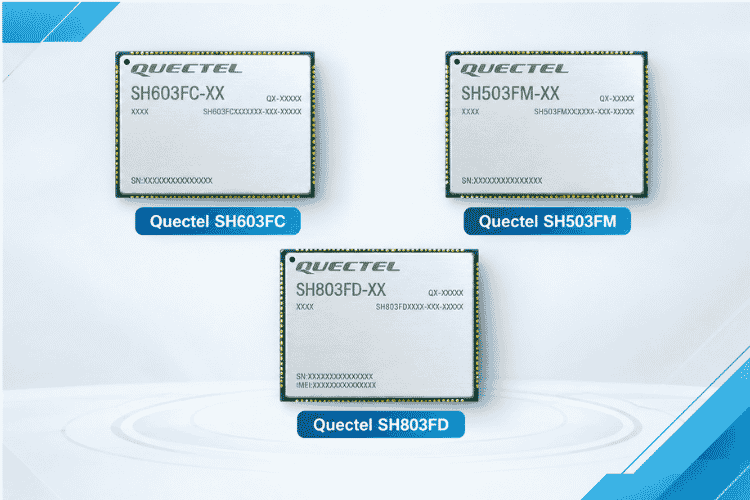
Quectel Wireless Solutions announced the launch of three new smart modules, the SH603FC, SH503FM, and SH803FD, at Embedded World North America on 22 September 2026. These modules are built on MediaTek’s Genio platform, combining octa-core processing with dedicated on-device AI acceleration. They are designed for a wide array of connected products that do not require integrated cellular connectivity.
This new product family offers entry-, mid-, and high-performance tiers, providing manufacturers with a clear upgrade path as their compute and AI requirements evolve. Each module is available in a Wi-Fi variant for products needing built-in wireless connectivity, and the SH603FC also comes in a pure application processor variant, allowing for custom connectivity solutions.
The modules share a common architecture, featuring an octa-core Arm Cortex-A78 and Cortex-A55 processor, an Arm Mali-G57 MC2 GPU, and support for Android 15 and Yocto Linux with Kernel 6.6. They support LPDDR5X memory up to 16GB and offer dual independent display output through MIPI(LVDS), eDP, or DP. Additionally, they provide a dense set of interfaces including LCM, camera, touch screen, microphone, UART, USB, I2C, SPI, RGMII, and PCIe.
A key differentiator for this family is the absence of integrated cellular connectivity, which Quectel states offers customers the flexibility to choose the most suitable connectivity solution while streamlining costs and certification processes. All three modules are qualified to commercial and industrial grade, backed by long-term supply commitments.
Source Link: Press Release
Specifications
| Product | Platform | NPU Performance | Camera / Video | Wireless Variants | Memory | Display Output |
|---|---|---|---|---|---|---|
| SH503FM | MediaTek Genio G420 (MT8371LV) | Up to 7.2 TOPS | Single-ISP camera pipeline; 16 MP at 30 fps capture; 4K at 60 fps playback | SH503FM-WF or SH503FM-AP | LPDDR5X up to 16GB | Dual independent output via MIPI(LVDS), eDP, or DP |
Key Features
- Quectel launched the SH603FC, SH503FM, and SH803FD smart modules.
- Built on MediaTek Genio platform, integrating octa-core processing with dedicated on-device AI acceleration.
- Common architecture features Arm Cortex-A78 and Cortex-A55 processors and an Arm Mali-G57 MC2 GPU.
- Supports Android 15 and Yocto Linux with Kernel 6.6.
- Offers LPDDR5X memory support up to 16GB.
- Provides dual independent display output via MIPI(LVDS), eDP, or DP.
- Features dense interfaces including LCM, camera, touch screen, microphone, UART, USB, I2C, SPI, RGMII, and PCIe.
- Designed without integrated cellular connectivity, offering flexibility in choosing external solutions.
- All modules are qualified to commercial and industrial grade with long-term supply commitments.
- The SH503FM delivers up to 7.2 TOPS of NPU performance, based on MediaTek Genio G420 (MT8371LV).
- The SH603FC offers up to 10.3 TOPS of on-device AI compute, based on MediaTek Genio G520 (MT8371).
- The SH803FD provides up to 10.5 TOPS of NPU performance, based on MediaTek Genio G720 (MT8391).
Applications
- Industrial smart tablets and rugged tablets.
- Smart intercom and recorder devices, including handheld terminals and smart home panels.
- Edge computing equipment, edge AI gateways, and multi-camera edge computing.
- Vending machines, logistics lockers, and smart POS systems.
- Aftermarket in-vehicle entertainment, digital signage, and companion smart displays.
- Robotics and smart home systems.
- Generative AI workloads, such as on-device meeting summarization and lightweight local language models.
- Light edge inference applications, including voice or basic object detection.
Availability
Quectel’s new MediaTek Genio-based smart module family comprises the SH503FM, SH603FC, and SH803FD. The SH503FM is offered as the SH503FM-WF or SH503FM-AP, the SH603FC is available as the SH603FC-WF or SH603FC-AP, and the SH803FD is available with Wi-Fi 6E and Bluetooth 5.4. The three modules were launched by Quectel at Embedded World North America on 22 September 2026, providing entry-, mid-, and high-performance options for products requiring on-device AI and connectivity without integrated cellular connectivity.