Industrial plating option with enhanced durability for a variety of harsh environments
Jetson Thor Modules Draw Less Power. How Should Edge AI Power BOMs Be Reevaluated?
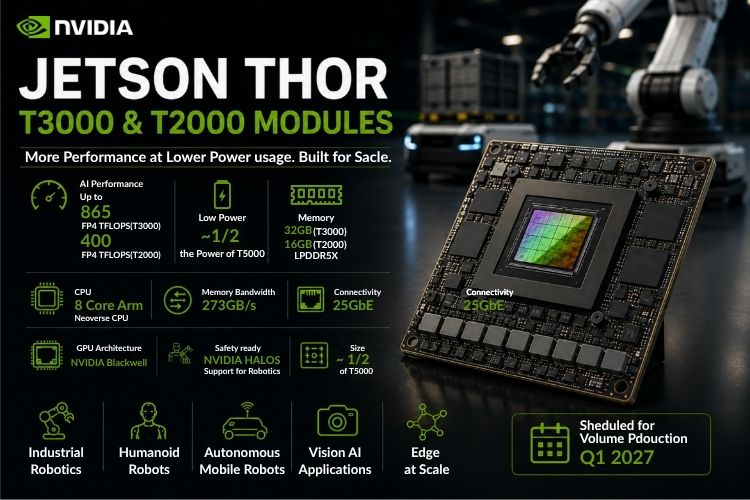
In July 2026, NVIDIA released two new modules: the Jetson T3000 and T2000. The T3000 delivers 865 FP4 TFLOPS and includes 32GB of LPDDR5X. Its size and power consumption are about half of the T5000. The T2000 offers 400 FP4 TFLOPS and 16GB of memory. It targets vision AI, AMRs, and industrial robotic arms. Both modules are scheduled for volume production in Q1 2027. The existing Jetson Thor platform can already simulate the T3000's target performance.
This shift shows that Edge AI is moving away from chasing peak compute alone. It now balances compute power, power use, physical size, and production cost. But lower module power does not mean simpler BOM design. The existing Jetson T5000 covers a power range of 40W to 130W. It requires carrier boards to supply 7–20V, 5V, and 3.3V rails. Until NVIDIA releases the official design guide for the new modules, teams should not directly reuse the power margin, power-sequencing, or thermal design from older platforms.
Platform Changes Are Reshaping the Power BOM
Edge AI robots often connect to cameras, radar, communication modules, and actuators at the same time. System load switches quickly between standby, inference, data transfer, and motion control. The power system must handle not only average power but also transient current, input voltage droop, power�up sequencing, and local temperature rise.
Memory configuration also affects platform choice. TrendForce expects DRAM contract prices to rise by 13% to 18% in Q3 2026. Suppliers continue to prioritise AI-related capacity. LPDRAM supply stays tight.
For Jetson platforms, memory is usually integrated into the compute module. So changes in memory price and capacity do not directly affect the carrier board's memory components. But they may influence which module size a company chooses: 32GB, 64GB, or others. NVIDIA has reduced memory usage for some workloads through software optimization. Some projects may move from 64GB to 32GB modules. A change in module size can also affect system power consumption, cooling needs, and power margins.
For these reasons, procurement and engineering teams should not evaluate power ICs in isolation. They should re-examine the entire power BOM based on the compute module, peripherals, and actual workloads.
What Procurement Teams Often Miss
First, do not replace a power IC based only on input voltage and rated current. Package, pinout, transient response, switching frequency, soft-start, telemetry interface, and operating temperature all matter. Any difference may require a board redesign or extra validation work.
Second, a working prototype does not guarantee stable mass production. The T3000 and T2000 will not reach volume supply until Q1 2027. Projects that start in 2026 must still evaluate BOM options across Orin, T4000, T5000, and the new modules in parallel.
Third, different end applications need different component grades. Industrial robots, vehicle-mounted equipment, and outdoor terminals should use commercial, industrial, or automotive-grade parts. For vehicle applications, teams must also check AEC-Q100 certification, operating temperature, batch traceability, and product change notification requirements.
Practical Steps for Power Design and Procurement
Step 1: Define the Power Budget and Leave Room for Adjustment.
Before starting the schematic, engineering teams should record continuous power, peak power, input droop, and thermal limits. They should set reasonable power margins based on load variation. For new modules without an official design guide, they should reserve extra adjustment room. They should not size the power supply based only on typical power numbers.
Step 2: Select Parts by Power Rail Level.
Take TI devices as examples. For 24V or 48V robot buses, teams can evaluate the LM5143-Q1. This is a 3.5–65V dual synchronous step-down controller. For low-voltage, high-current rails, they can evaluate the TPS546D24A. This single device supports 40A and can be stacked to 160A. The INA238 is a 16-bit current, voltage, and power monitor for buses up to 85V.
These parts can serve as reference choices. But actual design work must also verify input range, output current, loop stability, EMI, cooling conditions, and the module's reference design.
Step 3: Build a dual BOM Early.
For projects planned for mass production in 2027, teams should validate both primary and backup power parts 3 to 6 months before formal supply starts. Engineering teams should check package, pinout, temperature grade, transient response, loop stability, EMI, and power-up sequencing. They should also define the conditions under which the backup part can be used.
The goal of a dual BOM is not to find a similar part only after a shortage occurs. It is to build a validated alternative path during the design phase.
Step 4: Include Supply Verification in Design Reviews.
A part that works technically may still have supply issues. For key modules, DC/DC converters, and power MOSFETs, procurement and engineering teams should update lead times, prices, and lifecycle status every month.
During prototype-to-production transitions, platform changes, or urgent restocking, independent distributors can help verify global inventory, production batches, and quality documents. They can also do an initial screening of candidates with more stable supply conditions. Then engineering teams can complete compatibility and reliability validation. WIN SOURCE can also help identify BOM risks early in this process. We connect inventory checks, alternative evaluation, and procurement execution. This reduces the impact of incomplete supply information on project schedules.
Edge AI modules are moving toward smaller size, lower power, and higher integration. But power design does not become simpler. The connections among compute modules, memory configuration, dynamic loads, thermal design, and component supply are becoming tighter. The earlier procurement teams join power budgeting, component selection, and alternative validation, the less likely a single part number, a lead-time change, or a platform shift will hold up mass production.
© 2026 Win Source Electronics. All rights reserved. This content is protected by copyright and may not be reproduced, distributed, transmitted, cached or otherwise used, except with the prior written permission of Win Source Electronics.